“Just about a year ago, I set out on the road,
Seeking my fame and fortune, looking for a pot of gold.
Things got bad, and things got worse, I guess you know the tune.
Oh, Lord! Stuck in Lodi again”

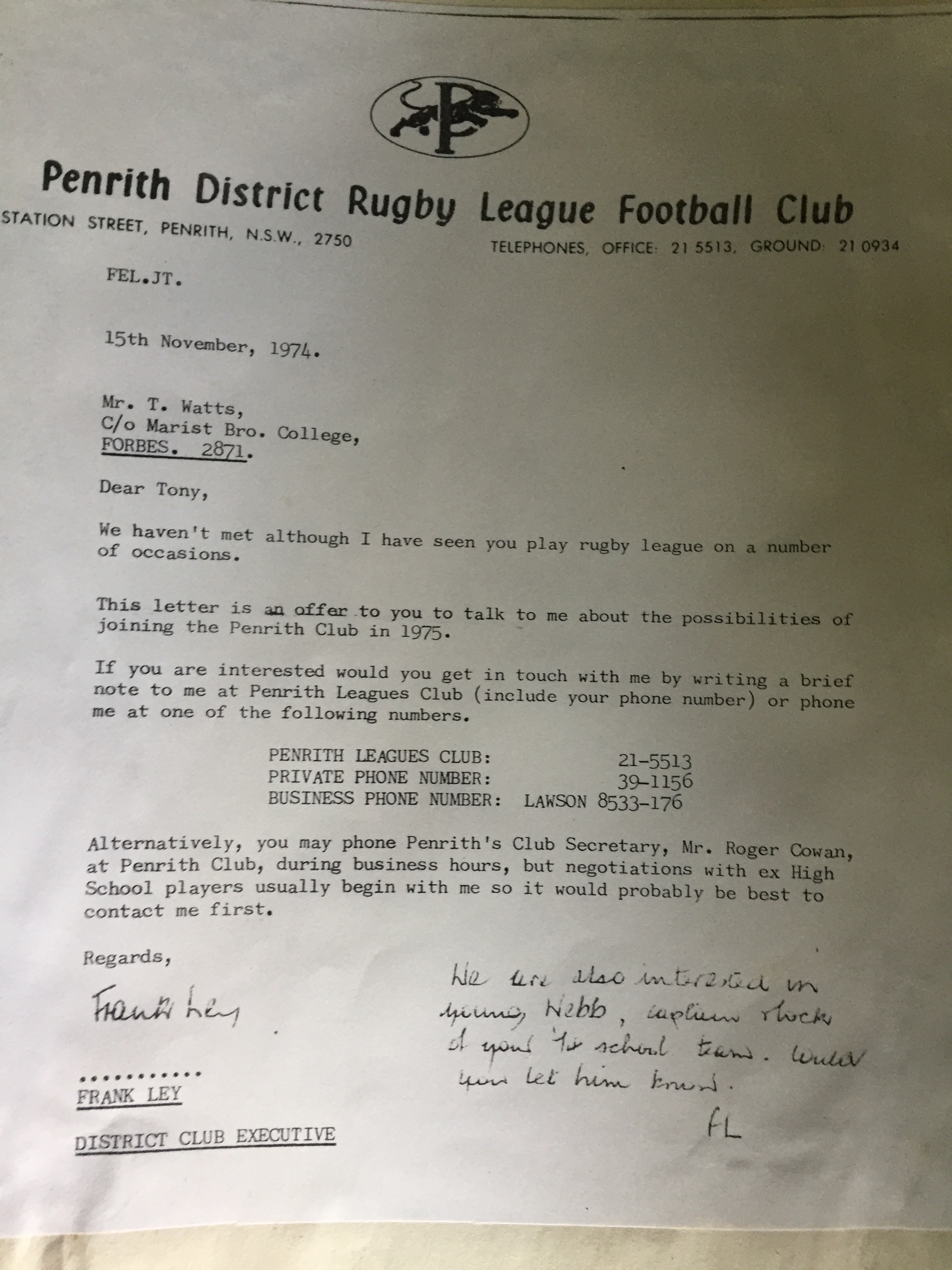
As I grew into my teenage self I theorised that I could short-cut difficult social situations and overcome the stigma of extreme shyness by becoming famous. This would mean that I would automatically be welcomed, without introduction, into new and potentially uncomfortable situations without the usual necessary backgrounding and running the gauntlet of rejection. I would simply be me, whose potential had been assessed and recognised, whose success was public knowledge by virtue of the media and word-of-mouth coverage that I had witnessed of others before me. I pursued this vision through Rugby League, the only obvious channel given the nature of my family and the school I attended. I found early encouragement through selection at a young age in the Open A side, and various awards that came with it. I believed that, one day, I would be approached to join a Sydney club, the heart of Rugby League at that time, and from there my dreams would be fulfilled. It was therefore a significant day in my life when an envelope was handed to me by a teacher after school one day, with the Penrith Panthers logo clearly evident on the front cover. I accepted it without a word and put it straight in my pocket, bursting with anticipation as I rode the bus into town and walked home from the bus stop. I took it to my room and read it silently to myself, hardly able to contain my excitement. With whom could I share such news? I had been told earlier by Forbes High School’s Australian Schoolboy Rep, Geoff Williams, that Penrith were interested in me, but a second hand expression of interest meant little. Of course there would be a difficult conversation with mum, who I knew through earlier discussions around the ‘second-hand interest’, was keen for me to finish school ‘at home’ in Forbes – it had been flagged in some circles that I might attend Patrician Brothers, Fairfield ( a feeder school for the Penrith and Parramatta clubs) on a football scholarship, but nothing was ever formalised. As it turned out, I remained in Forbes for another year to finish my schooling at Red Bend.
After I finished school in 1975, I picked up some holiday work in Forbes while awaiting HSC results. An executive from the Penrith club rang me at home and at work on several occasions but I was never available to speak to them (no mobile phones then). Somehow, I don’t remember how, I got the message that I was still on their list of targeted recruits and that I should come to Sydney. Of course I was extremely keen to do so, despite not being a fan of Penrith, and I again had the discussion with mum about leaving home. Earlier, one of my friends, Peter Hourigan, had said that if I ever came to Sydney to take up the Penrith offer, I could stay with them. I decided that this was what I would do. It would not be true to say “I made arrangements to do this” because I have no idea whether the adults in all this – Mum, and Mr & Mrs Hourigan- had discussed this or agreed to this. It just seemed like the only thing I could do to make this a reality. In January of 1976, I packed a suitcase, and mum drove me to the railway station.
Seven Hills was my destination. Mum gave me a $50 note to purchase a train ticket. As I watched, or listened to the ‘teller’ counting out change, I got the distinct impression that he was miscounting. This made me uncomfortable but a little excited, as I had never had any money of my own and I thought there was the possibility I was about to be ‘given’ some. I did not count the change, for fear I would confirm my suspicions, but put it straight into my pocket. Mick had accompanied mum and I to the station and gave me $20 as I boarded the train. It was a sad departure, as these leaving home moments always are. I was alone, and on my way. The train soon arrived in Parkes, and an announcement was being repeated loudly over the train’s speaker system. “We are looking for a passenger traveling to Sydney”. I felt my stomach flip. A guard was walking up and down the aisle asking everyone where they were heading. I kept my head down, but soon he arrived at my seat and directed the question to me, “Are you going to Sydney?”. This gave me an out, and I replied “No, I’m going to Seven Hills”.
This didn’t work. I was interrogated then, in front of other passengers, as to whether I had bought a ticket in Forbes. I said I had and, to my surprise the guard said, “Well, we’ve over-charged you!”. I leapt on this, and asked how much they owed me. “No, I mean we’ve under-charged you,” he quickly corrected. As I still had not counted my change, I asked “how much?” . They didn’t seem to know either, and asked me how much money I had on me. I pulled out my bundle of money, and was relieved of an amount for which I’m sure there was no reasonable calculation. They asked if I had more money on me, and I don’t know why I confessed, but I produced the $20 that Mick had given me. “Why didn’t you buy the ticket with this?”, I was challenged. I told them that I had been handed that money as I boarded the train, and was allowed to keep it. My new-found wealth was short-lived, I had barely left home and already been humiliated and ‘robbed’. They would be sorry when I was famous! (I have since reflected that I have never heard of a train being stopped to rectify an overcharge or undercharge, and if it has ever happened anywhere in the world again!)
Arriving at last at Seven Hills, with no ‘arrangements’ having been made, I grabbed my suitcase and began the long walk to Hourigans, the general direction I knew from previous visits. It was well over an hour to their home, and I approached the front door and knocked. They were home, but I still had that lingering doubt as to whether anyone actually knew I was coming, why I was there, or how long I might be welcome to stay. No matter, they were very welcoming, and rearranged their home to allow me a bedroom of my own. Within the next few days, Mr Hourigan loaded us in the car and drove out to Penrith to see where the club and oval were located. Before actually attending training at Penrith, I attended training with the Hills District club, the Baulkham Hills Bulls, where the Hourigan boys were intending to play. After a couple of games of touch footy with the Under 19’s, I was asked to play for the A Grade team. This should have been an early warning sign of the quality of the team I was joining, but I enjoyed the experience and rubbing shoulders with some of my childhood heroes like Bobby Moses, who started the season there as Captain/Coach.
Around the same time, I started training at Penrith. I caught the train to Penrith and walked the short distance to Penrith Park, finding an official-looking person and introducing myself. I was taken to the sheds, and spent some time having ‘vital statistics’ recorded – height, weight etc. I weighed about 10 stone 4 pounds then, which is around 65 kg. I was introduced to the coach of the Under 23 side, and joined the squad for training. I trained hard, and made it to the end of the first session. Afterwards, I caught the train home. It was then I learnt that, after certain hours at night, the trains did not run all the way back to the city, or even to Parramatta, but terminated at Blacktown, quite a few stations short of Seven Hills. I was ejected, tired and anxious, into the streets of Blacktown after dark. It was terrifying, not knowing where I was or how I was going to get home. I walked along the street beside the station and tried several public phones, none of which successfully connected to the Hourigans. Luckily for me they had registered my attempted calls and driven to several train stations in search of me, finding me wandering still around the neighbourhood of Blacktown Station.
By this time, my HSC results had arrived and I had begun a course in Computing Science at the Institute of Technology (now the University of Technology, or UTS) in the inner city. I was not really committed to a Computing career, I had been hoping to get into journalism but as this course was full (of people with better marks), it was suggested I start the Computing Science degree and transfer at the end of the year. Computing Science would have been great if I had owned a personal computer, but unfortunately they hadn’t been invented yet. There was only one computer at the University, it took up all of the 20th floor of the main building, and our group got to see it once, during orientation. The closest I got to it afterwards was the key-boarding room, where computer code was punched onto cards, collected and ‘fed’ into the mainframe computer. After writing a computer program, feedback was slow. The turnaround for the printout to return from the computer room was around 3 weeks. Hence, I would receive printouts saying “error in line 01”. Rewrite line one, re-submit the cards, wait three weeks, read “error in line 02”. A very frustrating exercise, given how instant feedback is today. Kindergarten children are now writing more complex code than I ever did!
The days were initially long and exhausting, as I adjusted to city life. I was getting up, sometimes at 5am to make my way to the train station, getting into the city for a day at uni (or later, for work at MLC Insurance) and then catching the train from the city to Penrith for a solid training session, then if I was getting the train home, having to beat the ‘termination’ time or else be wandering Blacktown streets again after dark.
Bobby Moses was recruited by Penrith as a coach or assistant coach, and Ivor Lingard, an ex-Great Britain five-eighth and Parramatta Eel, took over as coach of the Bulls. I was soon able to establish that Bobby Moses and Bob ‘the Bear’ O’Reilly travelled through Seven Hills on their way to training at Penrith. I arranged to wait for them on the edge of the main road, and was soon able to re-direct them to a ‘short-cut’ which took them closer to where I was living, and helped avoid a few train trips. They were not always keen to leave straight after training, though, as drinks were an important part of the culture, so I still had to find my own way home. Later I got to know a couple of other young hopefuls from the Parramatta district and began travelling with them to training and games.
Penrith U23’s…..
At Penrith, I trained harder than I ever had in my life. I had expected this, and despite my aversion to physical exhaustion I took no shortcuts. When asked to sprint 200m, for example, I would sprint 200m, not cruise for 100m and sprint the rest. I was very fit, and also very scrawny. Not much was known about healthy eating and building muscle mass – not by me anyway – so I remained a lightweight by comparison to some others. After a month or two of solid training, the train sagas as mentioned, and even a few trial games, I was approached in the ‘sheds’ one night with the question, “Where have you been?”
“What do you mean? I haven’t been anywhere.”
“Well, you haven’t weighed in since the first night, so we have no record of your attendance at training since then!” I was shocked. I didn’t know I had to weigh in every week, didn’t think I was important enough yet to be tracked and monitored. And I was disappointed that my wholehearted efforts to impress had amounted to nothing! However, the truthful explanation, that I’d been there but not known the procedure, was quietly accepted and we moved on.
I played several trial games with the Under 23 side, mostly as a five-eighth, and experienced highlights like playing at Brookvale Oval on the same day and the same ground as Bobby Fulton (just a couple of hours apart). I didn’t do anything exceptional, just shoveled the ball out the backline like I thought a good five-eighth should, made my tackles, scored the occasional try, and slipped quietly away after the games were over. The Penrith club wore the old brown and white perpendicular striped jumpers then, but were moving to a new strip the following year, which was one of the enticements offered to me, along with a tracksuit with my name on it. It was also not uncommon to be approached before or after a game to sign autographs for someone hoping it might be valuable one day.
You need to know here about the 13 Import Rule. There was a time in rugby league you couldn’t play outside of the area you lived. In 1975 the 13-import rule was introduced, restricting clubs to 13 players from outside the area (imports) across all three grades. This was to counter the poaching of talented players by the wealthy clubs, as Manly did in the early 1970’s. But that ended in 1984. So in 1976, when I went to Penrith, I was regarded as an import. At the time of my arrival, Penrith had 11 imported players on their books. I was told they would likely fill their 13th spot with a high-school graduate, and that would be me. Not long after, I read in the news that Penrith had signed Bill Ashurst and David Topliss, two Great Britain Internationals, to link up with the already signed Captain-Coach Mike Stephenson, thus completing the maximum 13 imports allowed, and ruling me out of a place in any of the top three grades (1st Grade, Reserve Grade and Under 23’s). The news was broken to me in person prior to the last of the trial games at Penrith Park. Just before kick-off against the North Sydney Bears, the coach cornered me and said this would be my last game, and they’d like me to play in the centres. This turned out to be my best performance at the club. By half-time I had scored three tries, including a length of the field intercept, at the end of which, with no players from either side yet arrived, I planted the ball and converted the try. As I walked off at half-time, Bobby Moses expressed his approval. During the break I was approached by several clubs in the Penrith District, including St Mary’s, to play out the season with them, but I was not keen to do the travel without the possibility of higher representation. I did continue to trial with the Panther’s Presidents Cup squad (Under 19’s), and was assured of selection there, but again, the 13 import rule meant I could not represent any higher grade until I’d played in the District for 2 years (making me a local). A Penrith official rang me at Hourigan’s and offered me a contract for that 2 year period which, he said, would make me the highest paid player in Sydney (in the President’s Cup division, which I don’t think received payment!). Because I was so keen on being able to move up the ranks immediately, and because of the hassle of travel to training, not having a car, and the remoteness of Penrith and, in fact, the vastness of Sydney which I had not imagined, I turned down the offer. “You’re mad,” he said, and that was the last I heard from them. I later learnt the sum of $500 I had been offered was the same amount Steve Mortimer was offered to join Canterbury!
Anyway, I continued with the Hills District, or the Baulkham Hills Bulls as they were known, and played five-eighth or centre for the A Grade side. I was also called on several times to play for the Under 19’s if they had an injury, so some weekends I would be playing President’s Cup with Penrith on a Friday night or Saturday, then two games on a Sunday with the Bulls. No problem, I loved my football. Ivor Lingard took over the coaching at the Bulls when Bobby Moses moved to Penrith, and he played a few games, but mostly coached from the sidelines. He was a harsh critic, to me at least, as I was a sensitive soul, and responded better to praise than criticism. One long weekend I decided to travel home to Forbes to visit mum, with the intention of returning to Sydney on the Sunday to play with the Bulls. However, when I got out there, I felt it was a dreadful waste of a long weekend to come all that way on the Friday and travel back Saturday, or on the Sunday morning. So I stayed in Forbes. I was very unpopular when I returned for training on Tuesday night. The team had lost by 100-0, and Ivor Lingard tormented me mercilessly all week about being ‘a mummy’s boy’ and became quite nasty about my absence. Not much I could say. Not much he could do either, I was picked again for the following week, and we lost by much less than 100!
On another occasion, must have been earlier in the season, we were playing one of the top sides – Mount Pritchard or Wentworthville, I can’t remember. I was definitely the baby in the team, if not exactly a mummy’s boy, as most of the players were men in their late twenties or early thirties, some ex-Grade players. I played well in the first half, making breaks and generally keeping the team on the front foot. At half-time I was warned to keep my head down in the second half, as the opposing centre would be out to get me. I managed to avoid any retribution, and we won the game (might have been our only win of the season). In the dressing sheds we sat around and went through the process of selecting the Players Player for the match. I still didn’t know everyone’s name, and sat for a moment to think. The fellow next to me said, “You played the house down today. You should put yourself down as the players player!” I was very flattered, and with no obvious alternatives, I did as suggested. “Hey everybody”, the same player loudly announced, “Tony’s just voted for himself!”. Lesson learnt!
Ivor Lingard was appointed coach of the Parramatta Under 23 side for the 1977 season. Despite upsetting him, I played well enough on most occasions through 1976 for him to invite me to trial with the Under 23’s. Same rules applied, I would be an import. At the end of 1976 I was carrying a dislocated A/C joint which had healed in the wrong position, and I had constant pain from inflammation in that shoulder. I was also poor and did not seek any medical advice beyond the initial consultation which resulted in me wearing a sling for a short period. The Hills District offered to pay for my rehabilitation at the Parramatta club’s preferred chiropractor on the proviso that if I was signed by Parramatta I would have to pay back their expenses. So I started visiting the chiropractor who was working on getting my shoulder back into place. At the same time I commenced training with Parramatta. Ivor Lingard met me at Cumberland Oval and introduced me to Terry Fearnley, the coach of the First Grade team that year. I trained hard again with the Under 23 squad of hopefuls, but was also invited by Ivor to train with the First Grade squad at other times, like Sunday morning road runs, running up the steps of the Opera House, or up flights of stairs at Parramatta high-rises (there weren’t many then!). I remember piggy-backing Geoff Gerard around the streets of Parramatta, and running up hills with Ray Higgs setting the pace! My highlight was joining the First Grade squad for a game of touch footy at the end of a training session, running off an Ivor Lingard pass and scoring untouched by the Parramatta stars of that year.
I played several trials with the Under 23 hopefuls, often only hours after having my shoulder worked back into place by the chiropractor earlier in the day. I was too intimidated to ask for any strapping or support for my shoulder, so tried to hide the injury as best I could. In one game the opposing five-eighth ran around me on that shoulder, and while I eventually rounded him up the damage was done and their winger scored in the corner. At half-time I was re-introduced to the wrath of Ivor, as he threw the kitchen sink at me for my poor defense. My attack was no better, as I had adopted the same philosophy that a good five-eighth passes the ball quick and early, and is not trying to self-promote with individual runs or kicks. My mistake.
On the day of short-listing selected players, I arrived at training with the other hopefuls. We endured the hardest training session yet. At the end of the session, Ivor read out a list of names. Mine was not among them. Nothing else was said. I went home, disappointed at not being selected, upset that nothing was said to me, and annoyed that we had trained so hard before being rejected! He could have read out the list at the start of training!
I continued my Parramatta connection by training with the President’s Cup squad (I was still eligible). I felt I could comfortably make the squad, but again my impatience at not being able to play at a higher level for two years led me to walk away. By this stage I was at Teachers’ College, and had house-mates playing with the College team. I decided to leave the Hills District (after paying back my debt), and joined the CCE (Catholic College of Education) team.
This competition, the University Cup, was largely made of players closer to my age and was a lot easier on the body than the thumping I was getting in the Parramatta District. By this stage I had pretty much abandoned my ambition of playing Grade football as I thought I remained ineligible. The College had a team in each of the top three Divisions of the competition and fielded very competitive sides. The first year I joined we made the Grand Final against Sydney University, and lost. I was selected in the Combined University Cup side and played in all games over the next three years of my college life. It was a star-studded side at times, with players like John Muggleton, Ross Conlon, and Neil Whittaker at various times making up the team. We never lost a match in that time, defeating teams like the Great Britain Amateurs, New Zealand Universities, and the Australian Combined University side, as well as a couple of other representative sides. We played curtain-raisers to NSW v Queensland, and an Amco Cup match, both at Leichardt Oval, and both a great experience.
 The Watts Family