30 March, 1911 ~ 14 September, 1958


Son of James Lawrence and Alice Maud (nee Hainsworth).
Married Mary Eileen Mahy (mum) May 29, 1940, at St Therese Catholic Church, Yenda, NSW.
Jim went to Buslingthorpe National Infants School and Buslingthorpe National Mixed school (co-ed), also referred to as Buslingthorpe Church of England School. The school was in what we would now call a deprived area of the city, with many children from poor families. However, Jim flourished here from age five years to fourteen.
He loved to perform. He was the star of the Buslingthorpe Concert Party, sang in the church choir and taught Sunday school. With a pleasant voice and attractive personality he’d sing, play the drums, and put on a show. He enjoyed doing this all through his life.If there was no musical instrument available, he would improvise with knives and forks, and empty drum, or even bottles.
When Jim left England the economic climate was harsh, unemployment was high, and many families were finding it difficult to get by. He took his courage in both hands and came to Australia under the Farm Apprentices Scheme for British youth, or the Dreadnought Scheme as it was known.
Under the Dreadnought Scheme boys aged fifteen to nineteen years were granted assisted passage to Australia where they were to learn basic farm techniques. The boys left England with a supervisor to watch over them until their arrival in their new land. Jim arrived in Australia aboard the passenger ship S.S. Berrima on January 14, 1929.
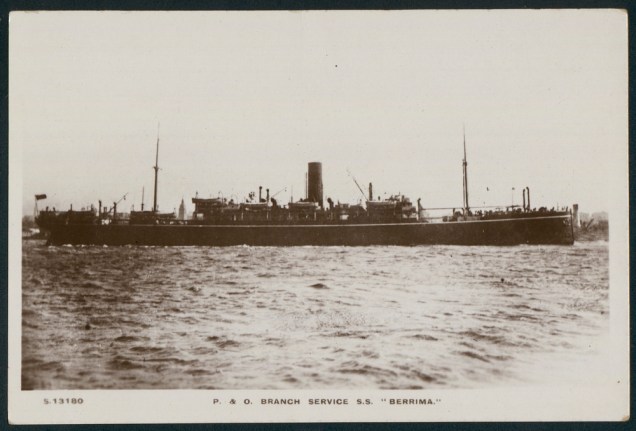
Once in Sydney they stayed on board ship one night and were taken to Central Station by their supervisor and put on the train to Mulgrave, which was close to Scheyville, just to the north of Windsor, northwest of Sydney, the location of the government training scheme and their final destination. They were transported to Scheyville by other Dreadnoughts on spring carts. Here they underwent their three months training, after which they were dispatched to all parts of New South Wales. The boys were required to work at least two years on their allocated farm in order to pay back the government for their assisted passage to Australia, then they were free to look for work elsewhere.
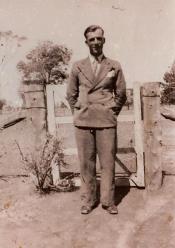
Jim was placed on a farm called “Sylvanham”, owned by Mr L Barber. It was near Merriwagga and was part of a mixed farming district where grain, cattle and sheep were farmed. He worked here for ten years and married Mary Eileen Mahy, who came to work for Mr Barber in 1939. They were married on May 29 1940 in the St Therese Catholic Church, Yenda, NSW.
He enlisted in the Australian Military Forces on June 1, 1940 and in early 1941 he was posted in Egypt. On his return to Australia he served in Sydney and Townsville, North Queensland.
After being discharged from the Army on October 23, 1945, he managed Quarterly’s general store in Yenda and spent a short time working with the CSIRO. Early in 1949 he secured a managers position on Gunbar Farm near Merriwagga.
In 1953 he was granted a property called “Rostella”, approximately 10 miles West of Barringun on the Queensland border, and 90 miles North of Bourke, as part of a government scheme for returned service personnel called “Soldier Settlers“. The government had divided large pastoral leases into smaller leases, and returned soldiers were required to apply for a qualification certificate. The ‘blocks’ were listed in a booklet with a number, location map, and description. “Rostella” was listed as follows:-
“Block No. 1340 (Chinaman’s); Map No. 10 (formerly part of Belalie Holding).
Each applicant filled in a ballot form listing their preferences from 1-15. Jim got his first choice! He was notified first by telephone. Colleen thinks she remembers it well.
She and Jimmy and a couple of the younger ones and mum were waiting in the car to go back to school or somewhere in Yenda. Dad was inside and mum was getting cross. She called out to dad to hurry up. He said he just wanted to wait a few minutes longer in case there was a phone call about the ballot. The call did come, and we finished up inside with maps all over the table and talking about our dreams. She can’t recall whether they actually left that day or not.
Then by mail in July 1953: “The lease will commence on August 31, 1953, on which date you take possession of the land”. And so this ‘British Migrant Boy’ had at last fulfilled a dream, to own his own patch of the Empire!
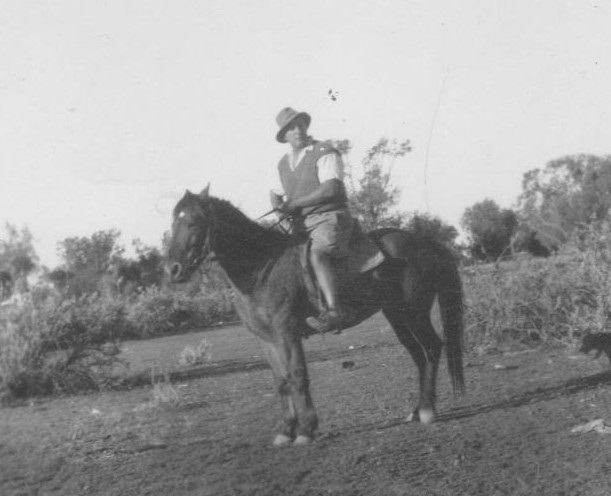
Upon moving to “Rostella”, Jim started to improve the property. There were no buildings or fences, he had to build up stock, and buy farming equipment. By 1958 there were ten children, one on the way and the property was doing well – the situation was looking good.
However, on the night of September 13,1958 Jim was killed in a car accident north of Enngonia coming home from a send off at which he had played the drums. His time at “Rostella” and his time on this earth was too short. James Frederick Watts was buried in Bourke.
I know you all remember or have heard the delight and interest dad took in us all. He had a personality that rubbed off and he was devoted to his family. He was generous to a fault and jovial and was well-respected and well liked – definitely a “people person”.
His death took a heavy toll. One never really recovers from the trauma of such tragic shocks, but gradually, with the love and support of family, you learn to live with it. Tragedy and death help you develop a healthy respect for love, family, and life.
(insert picture: Dad on the Ferguson-“the Fergie” at Rostella)
Editors Note: After Mum moved us all to Forbes in 1960, every school holidays she would bundle us up like sardines in the Holden Station Wagon and take us “home” to “Rostella”. Unlimited freedom, wide open spaces and, at night, huge expanses of stars. Here our spirit was renewed. It was through these holidays that the young ones also learnt to love “Rostella”.
 The Watts Family