9 February, 1920 ~ 29 January, 2006
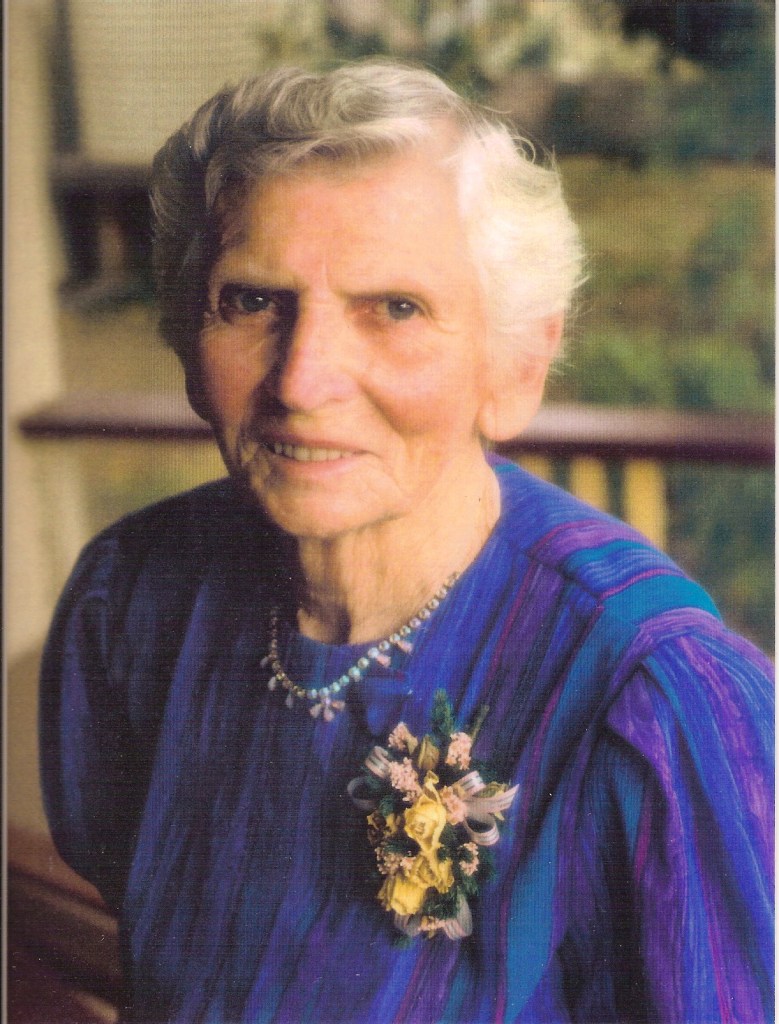
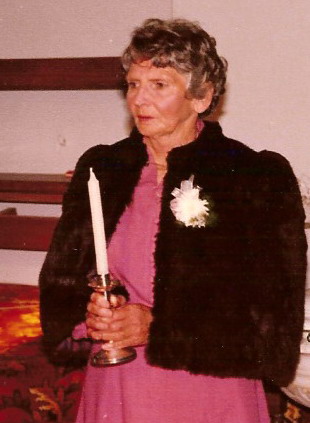
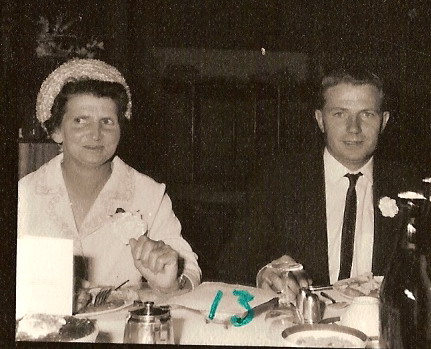
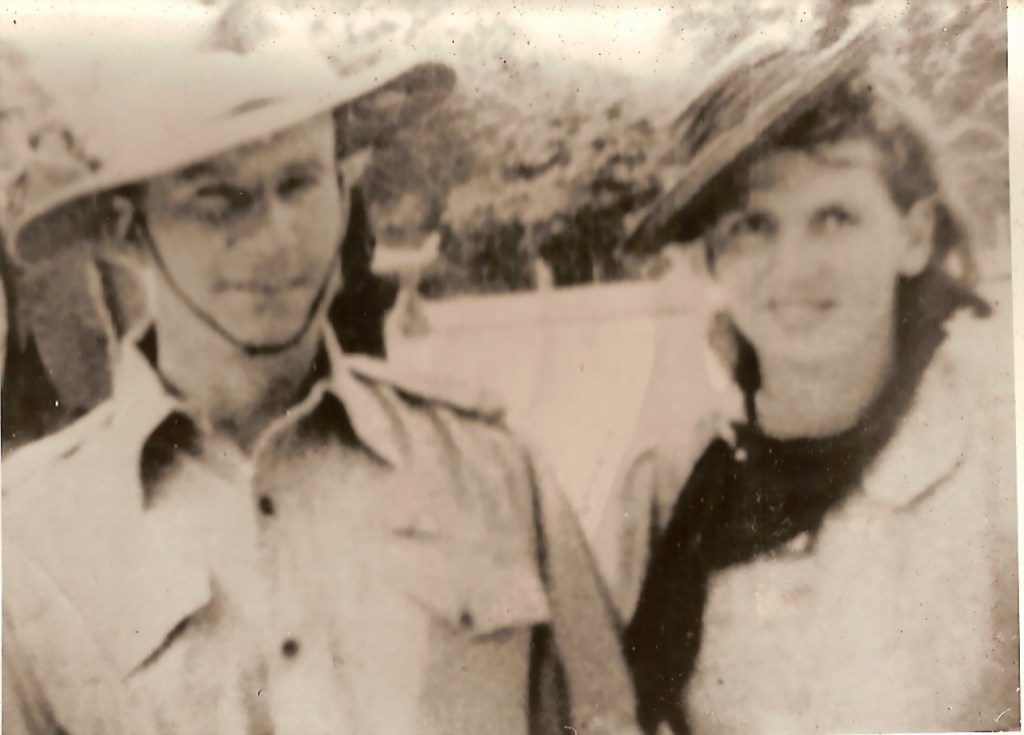
Mary Eileen Mahy, born February 9, 1920, at Howlong, NSW. First daughter of Stephen Mahy and Antoinetta Mahy (nee Gersbach).
Mary’s Memoirs: Dad had a blacksmith and wheelwright business in Yenda on the corner of Bingar and West streets. It was a corrugated iron shed, with a big open fire place and big bellows. previous he was in partnership with a Jim Day in Howlong, a business called “Mahy and Day”. Today the old building is a garage.
We came to Yenda when I was a baby. Yenda was a tent city then. Mum contracted typhoid fever and Aunty Ida and Uncle Jack looked after me for six months. During that time Dad built a house on a two acre block near the irrigation canal, Farm 751 Canal Street, Yenda.
We had poultry of every description, a vegetable garden and fruit trees and Mum always had a flower garden. We always had a cow and Mum separated the milk to make butter. She made our bread, and of course the preserves, jams and pickles. She had a “Singer”treadle sewing machine and made most of our clothes.
I was four when I started school in Yenda and remember very well being sent off with my older brother Phil and his mate from across the road, Darby Kennedy. “Now take care of your sister!” That was fine until we got to the gate and then they said, “G’orn, in you go, we don’t want any girls around us”. I crept in on my own but loved school from that day on, even though I did have a few weird teachers.
With the canal at our back door swimming was the favourite past-time after all our work was done. We were all quite accomplished too.
I well remember my first bike. Dad bought it second-hand, painted it, and put new tyres on. I couldn’t wait to ride it. I hopped on and rode down the back yard and a piece of wood with nails sticking up was in the way and I rode straight over it, puncturing both tyres! I had a few close shaves flying down the hill with Jim on my handle bars but somehow he never came off.
Church was once a month, when Father O’Dea would come from Griffith. The church was a tin shed with a dirt floor. One day on my way home from school a wild storm blew up. I saw a few trees fall over, then a fence, then the Methodist church. The Catholic church was also blown away. Dad, with the help of a few residents, rebuilt the church, still a tin shed but this time with a board floor. In later years it was lined and used for entertainment, concerts and dances.
I remember going to Leeton with Mum in her horse-drawn buggy to see “Big Mumma and Dadda”, our grandparents Sara and Phillip Gersbach, on their farm.
One day Day and his friend went to Hay to buy a car.I think it cost one hundred pounds, a bright red model T Ford.We met dad at the front gated all piled in for a ride the back gate. Great excitement. We would drive to Leeton in the car, stay with Aunt Chrissie and Uncle Jack and visit all the “rellies”.
Christmas was a big occasion for our family. Mum and her sisters would go home to our grandparents farm days before and cook plum puddings, turkeys, chooks, and a fruit cake for the great day.
There was a big room in “Big Mumma’s” house where they would set up tables for all the adults, and more tables on the verandahs for the children. The priest would come from Leeton to say Mass, then stay for dinner along with lots of aunts, uncles, cousins and friends.
“Big Daddy” had an orchard, mainly apples, for which he won prizes at the Sydney show. There were also peaches, pears, apricots, cherry and mulberry trees, and strawberries. You name it, and he grew it. We kids drove our mother to distraction “ruining our Sunday best” by climbing the trees to eat the fruit.
New Year’s weekend was generally spent camping at Pennywitches Beach near Whitton on the Murrumbidgee River – this was what our father enjoyed most.
At about nine years of age I left Yenda to board at the convent in Wombat, a tiny village near Young. It was a very inexpensive school and a very cold one. If you complained of being cold the nuns would tell us to “run up the hill”. I suppose they were just as cold. A year of this was enough and, when Sister Joseph, who was in charge, was transferred to Leeton, half a dozen “Wombats” went with her.
Thel, my sister, and i were at boarding school in 1933 when Dad died from cancer in the Lewisham hospital in Sydney. There were no X-Ray machines in Yenda; he was taken to Narrandera but the machines there weren’t suitable as they didn’t x-ray deep enough. He was then transferred to Sydney where he died a week later on July 6, 1933.
Mum came back to Grandmas and we stayed in Leeton until Sarah was born on October 6. Mum stayed on the farm until Grandma died on December 22, 1933. She then returned to Yenda.
In 1934 I was sent off to Mister Quinn in Wagga where I learnt typing and office procedure. Mum said I was too young to go to work and I think she planned to make a nun of me. At seventeen I went to work in a stock and station agents called Hanrahan’s.
Dancing was a favourite past-time and my favourite partner was Bernie, my brother. We used to go to Myall Park, Binya and all around, including Yenda. On odd occasions, depending on how far we had to travel, arriving home in time for breakfast, and then off to work. They were good times and we had good fun.We also played tennis at night at McWilliams winery and weekend days at “Curran’s”, a mile or two out of town.These days sometimes ended in a bit of a party at night.
In 1939 I had an opportunity to work on a property called “Sylvanham”, near Merriwagga, owned by Lyn and End Barber. So I stretched my wings and left home.
It was here that I met James Frederick Watts and, a year later, on May 29, 1940, we were married at St Therese Catholic Church in Yenda by Father John Byrne. Although the paper reported a great list of forty entertained at my Aunt Daisy Farley’s home, there were in fact only three others present – my mother, my sister Thel, and a friend, Pat Pauling. We walked to the church, and while there it started to rain. From the church we went to the cafe where we had hot pies for supper, then back home to my mother’s place where we spent two days before Jim caught the train to Sydney and the army.
When Jimmy was born on October 6, 1940, Jim had a week’s leave, then had to go back to Sydney to prepare to leave for Egypt. He wrote every day. I received bundles of letters and telegrams. In return, I took so many photographs of Jimmy it was unreal.The most photographed baby in town, but some went off in every letter I wrote.
During the fruit season I worked in the co-op shed sorting fruit to be sent to the cannery in Leeton. Lots of women were employed in these jobs which weren’t really hard work, and I enjoyed the company.With the money I earned I was able to send Mum and Sarah for a holiday in Sydney. Mum had been so good helping look after Jimmy.
Bern and I went dancing occasionally. I had always loved to dance, and there was always something on to raise funds for the Red Cross.
One day a telegram arrived to say “Happy Birthday“. We had planned that if I got a telegram for birthday greetings on a date which was not my birthday, it would mean Jim was coming home. I think a lot of people got birthday greetings!
It was so exciting, but when and where I didn’t know. Finally they landed in Freemantle and came across to Adelaide where leave was granted, and Jim came home for two whole weeks. It was a wonderfully happy time.
A few weeks later, camp was shifted to Sydney to the Dutch Consuls house in Vaucluse. Jimmy and I went to Sydney for the first time. The train were terribly crowded, people slept on the luggage racks and on the floors of the corridors. It wasn’t wise to leave your seat or someone else would grab it. I knew some of the soldiers travelling and when I went to the toilet someone would mind my seat for me. They also bought food at the cafeterias so I didn’t have to leave the train. It was a long trip for me, this being the age of the steam trains, from two in the afternoon til six the next morning.
On arrival Central Station, Jim was there with the Brigadier’s car and driver to take us to our flat at Coogee. I guess this was our honeymoon as Jim was able to come home every night. He would leave at seven or earlier in the morning. Those days were sometimes long and lonely, people streaming all around and not a hello or smile from anyone, or so it seemed.
Almost every evening Jimmy and I would catch a ferry to Neilson’s Park and go around to Vaucluse House to have tea with the soldiers. The officers ate upstairs and we ate downstairs. No-one seemed to mind a stray woman and her child.
I’m not quite sure when my brothers Bern and Phil arrived to be stationed at Maroubra and Bondi Beaches respectively, but they were there when the Japanese submarine came into the Harbour (June, 1942).
I remember that night so well. The scream of the air-raid sirens. I was so terrified I could not move to get Jimmy from his bed beside me. I could hear the planes overhead. Jim just listened for a while and said, “Not to worry, they are just our planes”. All this time I could hear people scurrying down the street to air-raid shelters. The only shell to hit anything fell in the street behind us and no-one was injured. Bern and Phil declared the next day that an “Ack Ack” man had drunk too much and fallen on his gun (Jim was in Anti-Aircraft). Later of course, the submarines were discovered and located in Sydney Harbour.
During that short stay of three months, we must have visited every picture and play house in the city and the suburbs. Half the time, or perhaps all the time, I had no idea where I was, and often on the bus returning home after an outing Jim would go to sleep. I knew there was a big sign near our stop advertising ice-cream, so often I woke Jim and had him off the bus before he realised where he was. Fortunately he could always find his way home.
Some nights we would spend on the Manly ferry – it was sixpence a fare but you could stay on board as long as you wished, and we would do just that. It was a cheap evening and very enjoyable. Jimmy (jnr) sometimes got to help the driver.
But time was running out and the move was on to the North – Bern and Phil had left andI had to return home to Yenda. Jim moved up to Brisbane and I was pregnant. Colleen was born on June 14, 1943.
I can’t recall what happened for a while but Col was toddling when I went to Sydney to spend Easter with Jim. They had moved back to Sydney and he was in the army stores in George St. We stayed in a hotel around the corner from St Patrick’s. Claire Little and her husband Kevin, who was also in the army, stayed there too. Clare and I spent our days wandering around (not too far). Col and Jimmy stayed with Mum.
On my return home, Mr Quarterly asked me would I like my husband home – what a silly question I thought – but answered “Of course I would!” Apparently the poor guy had cancer and wanted someone to run his store ( a general store in the main street of Yenda where Thel also worked. A few days before peace was declared Jim was discharged from the army and was on the train at Goulbourn when the news came through.
Mr Quarterly gave him the job in the store and we had a house on a farm out of town (McKay’s). Most of our savings went in the purchase of a car (Betsy) – a square box on wheels. After a few months we got shifted back to town and when Peter was born we were living in a shed which had been converted to living standards, with partitions and cement floors, only a few doors down from Mum’s. Soon however, the house behind the shop came up for rent and we moved in there – across the road from the police station.
While living here Jim took part in every fund-raising event in town. We were supervisors of the Catholic Youth Club, and here he ran concerts, which he loved. One I especially remember was “Show Boat” – some very good music with comic strips here and there. For one strip – “Fairies in the Garden” – Jim (who was 14 stone and not very tall) was fairy queen in a tutu and sand shoes, while the other “fairies” were fellows six foot tall.
At that time nuns could not go to public entertainment, so Jim invited them to a dress rehearsal. They laughed till they cried, and to think I had been so worried about what they would think.
We stayed in the house until Patrick was born. By this time the government had started a scheme for Soldier Settlers, and in view of having something to offer, Jim went to work for CSIRO. His job was mainly planting trees in experimental plots at Moombooldool and Tabbita.
From this job we went to Gunbar Farm, which at that time belonged to a butcher called Lionel Crump. The house was old, but big. It was built of pine ,logs lined with hessian and wallpaper. The stove was about six feet long with a hot water tank built in beside it so that one wall of the kitchen was almost taken up with it. Here I became familiar with snakes – I had seen one or two at a distance before. On looking over the house I found a big stick behind each door. I wondered what they could be for, and I soon found out.
Rarely a day went by without a snake getting into the house somewhere – mainly the kitchen or pantry. I would hold them with one stick and hit them with another. In the laundry, which was separate from the house, a few floor boards were missing and a big snake lived under there. I would always have a good look to see if he was home before I ventured in to do the washing. One also lived in the toilet pit but it was safer there if he was home, as he wouldn’t come crawling in while you were ‘busy’. Fortunately, no-one was bitten.
While we were here Jimmy and Colleen stayed with Mum in Yenda to go to school. We had good neighbours in Muirheads on ‘Grover”, McDonalds on “Trelawn” and Naylors on “Fairfield”.
We had two phones in this house – one at each end of a long verandah. One was a party line to Hilston and the other to Gunbar. On days when tennis or other outings were being arranged, I would be detailed to pass messages from one party line to the other. Once, a bushfire broke out on McDonald’s and while the men were away fighting I spent my day climbing up the windmill tower to look at the fire, and spreading the news over both phones. I worked harder than the men!
By this time, Kit and Harold had decided to come out from England. Kit was Jim’s only sister and he had left home at seventeen, so it was nearly twenty-five years since they had seen each other. At the time they were due to arrive, I was expecting Kathy, so I had gone home to Mum (how would I have managed without her?). Jim and Jimmy went to Sydney to meet the boat. They met Kit and Harold and came back to Yenda. After a few days in Yenda they set off for Gunbar.
It was a good year and the rain tumbled down. Unfortunately the car bogged down about five miles from home and Kit has often talked of the walk, Jim saying “It’s only a little way”, and her dragging a fur coat across a ten thousand acre paddock. She had also taken the little ones home with her and I was to follow a few weeks later.
Kit told stories of trying to milk the cow – “like squeezing bloody sausages”- and getting nothing, and of the pumpkin which was “cow-feed”, and she was horrified to see it cooked and eaten. But the meat astounded her most of all. Each week Lionel would send a great box of a variety of meat out from Griffith, and at first Kit, Harold and Jimmy Robinson would just look at it. Having come through the war years in England where meat was a rare treat, they just couldn’t believe it.
Harold got an engineering job in Melbourne and they moved on. When they visited Gunbar a year later, they would walk miles to set a rabbit trap, and eat rabbit pie every second day. Brian, their eldest son, came out from England a few years later, in 1955, to join them.
1953 was the big year. The settler blocks were open and we had applied for them. Jim’s first choice was “Chinaman’s” block on the border, eight miles from Barringun. He talked constantly of what he would do when he got it, and the kids could go to Queensland every day! We actually drew the block he wanted.
On September 4, Jim set off for Barringun with the furniture, and Michael was born in Griffith just before he left. There was no dwelling on the block, but Mr Lack, who owned Tattersals Hotel in Barringun, also owned the old police station house across the road, and it was arranged that he would let us have it while we got settled. Jim then came back to Yenda.
When Michael was six weeks old, we bought a little Commer utility and headed for our new home. Michael was packed in a tomato box on the back of the seat, a couple of little ones were in the front, and the rest in the back. We camped overnight at Gilgunya.
All that was left of the town was a few chimneys standing out in the open. Luckily it didn’t rain on the way and we arrived hot and dusty and tired, but otherwise in good spirits.
On my first trip out to “Rostella”, I nearly turned back. It hadn’t rained for ages, the black soil was bare with cracks so big that the little ute nearly fell into them. However, I loved “Rostella” from the moment I saw it. I could….
“…See the vision splendid
Of the sunlit plains extended
And at night the wondrous glory
Of the everlasting stars.”
(BANJO PATTERSON’S “CLANCY OF THE OVERFLOW”)
Jim would go out to the block every day, and mostly we would go with him. Life was so good. Mr and Mrs Lack were really wonderful to us all, but especially Terry, whom they spoiled completely.
Then the river rose and flooded the country. I was by myself most of the time and the ‘blacks’ would camp across the way and come over every half hour for food or anything they could think of. Mrs Lack was always very kind to them and gave them all the food they needed, and then they would catch the mail truck to Bourke or Cunnamulla.
Jim erected a tin shed and we moved out to “Rostella”. A few sheets of canvas divided the shed into rooms but I had a super kitchen – a cement slab under the stove which had a hot water tank, and shelves all around to hold food and crockery. There were no doors and we had holes for windows.
The greatest trouble was wild pigs which ate the chook-feed and the potatoes that I had stored on netting outside the kitchen. Often at night Jim would sit at a window and shoot a few pigs.
My ‘laundry’ was a couple of kerosene tins on a fire down by the creek. The clothes line was a rope from tree to tree. Occasionally I saw a snake, but never anything like Gunbar.
The first thing to be built was the wool-shed. It was built on steel pylons to house sheep underneath in wet weather. The kids had fun climbing in the rafters like young monkeys. While the shearers’ quarters were being built we lived in the wool-shed. The rooms were dividd up with hessian bags.
Before Chris was born, my sister Sarah’s fiancé was killed in a car accident and I went and stayed with Mum while Sarah had a break in Wollongong.
Chris was born in Griffith hospital in October, 1954, and while we were away the river rose again. Jim could not get out to come for us, so Donny Ross took us back to Bourke. We took a wrong turn at Cobar and ended up in Louth, but eventually we reached Bourke and Enngonia. From there, Don Keighly, who ran a taxi service, took us to the crossing at Robinson’s, down from “Wirrawarra”. The bridge was not yet built, but Jim met us there and home we went. It was so wet, but it was good to be home again.
Jim had built me a wardrobe and sent to David Jones for new clothes-dresses, nighties, undies, aprons, even a new housecoat. It was a nice surprise. I had written a letter to Jim to ask him to send me some money to buy some new clothes before I went home. He sent a message back saying, “no”. I was a bit put out but I didn’t know of course that he had already planned to surprise me.
In the next few years the river seemed to be up and down all the time. Eventually the shearers’ quarters were built and we moved in there. How good it was to have rooms for the kids to sleep in. I felt like I was living in a mansion!
1957, and Tony was born in Bourke District Hospital. Two months before he was born, we went to Melbourne to see Kit and Harold, who had by this time bought a house at Moorabin. The boys – Jimmy and Peter – were at school in Forbes, and Colleen was boarding in Wellington.
Things were looking so good. We had almost paid off all we owed and were planning to build a house. In 1958 I was pregnant with Greg. On September 13, Jim went off to play at a send-off for people at “Belalie Station”. I kissed him goodbye at the gate and never saw him again. Mick stood with me and watched the car drive away.
A full moon was rising and Mick said, “Look, Mum, he’s going to the moon”. For many years he believed his father was on the moon and smiling down on us. I hope he still is. Sarah and Kevin Raines were staying with us that night and when Jim didn’t return we presumed he was too tired to drive. However, Noel Biddulph found the car where it had run off the road into a gully in the early hours of the morning. The exchange used to close at ten on Sunday morning so Jimmy rang to see where his Dad was – they asked him to put Kevin on and relayed the sad news. Why they didn’t let me know at seven when he was first found I will never know.
Now my strength lay in my children. They were all so good and helpful. Sarah and Kevin took the younger ones to Mum in Yenda, while I stayed in Bourke to have Greg. Jimmy stayed at “Rostella”. People were very kind to me. Greg was born in Bourke District Hospital on November 7, 1958. Jimmy, Colleen, Greg and I travelled to Yenda and stayed till after Christmas.
In 1959 Col, Jimmy, and the little ones stayed home at “Rostella”. Pat, John and Peter were at Red Bend College, Forbes, and Terry was at Wellington. Col worked for Ridges for a while, then went to Bulli to do her nurses training. We battled through that year with a bit of help here and there. We bought the blue Holden Wagon and I learnt to drive by getting out on a clay pan where I couldn’t hit anything.
It was decided that a house should be bought somewhere near a school, and Peter declared if he couldn’t go to Forbes he wouldn’t go to school. So Jimmy and I travelled to Forbes and looked at the houses for sale., with the view to adding a verandah or something, but nothing we looked at was satisfactory. Then the agent said to come and look at a house which came on the market only the day before. So we acquired 67 Hill Street (or Number 11 as it was then). As soon as the front door was opened Jimmy said, ‘This is it, Mum” – the price was £3000.
We went back to Bourke to finalise matters, then we all came over and stayed at the Royal Hotel owned by Brenda Gibbon (nee McCullough) for a week, in which time we cleaned and furnished the house. We moved in on February 9,1960 – my 40th birthday – they say “life begins at forty“. Soon everyone was settled into school and Tony, Chris and Greg were still at home to torment me.
And so the years rolled on – some at the College, some at South Forbes, the girls at the Convent. my life became a round of cleaning, cooking, washing, driving kids to school, to sport, to here, to there – to everywhere!
The family home in Hill Street was sold in February, 1992, and a house purchased at 12 Mermaid Crescent, Port Macquarie.
 The Watts Family