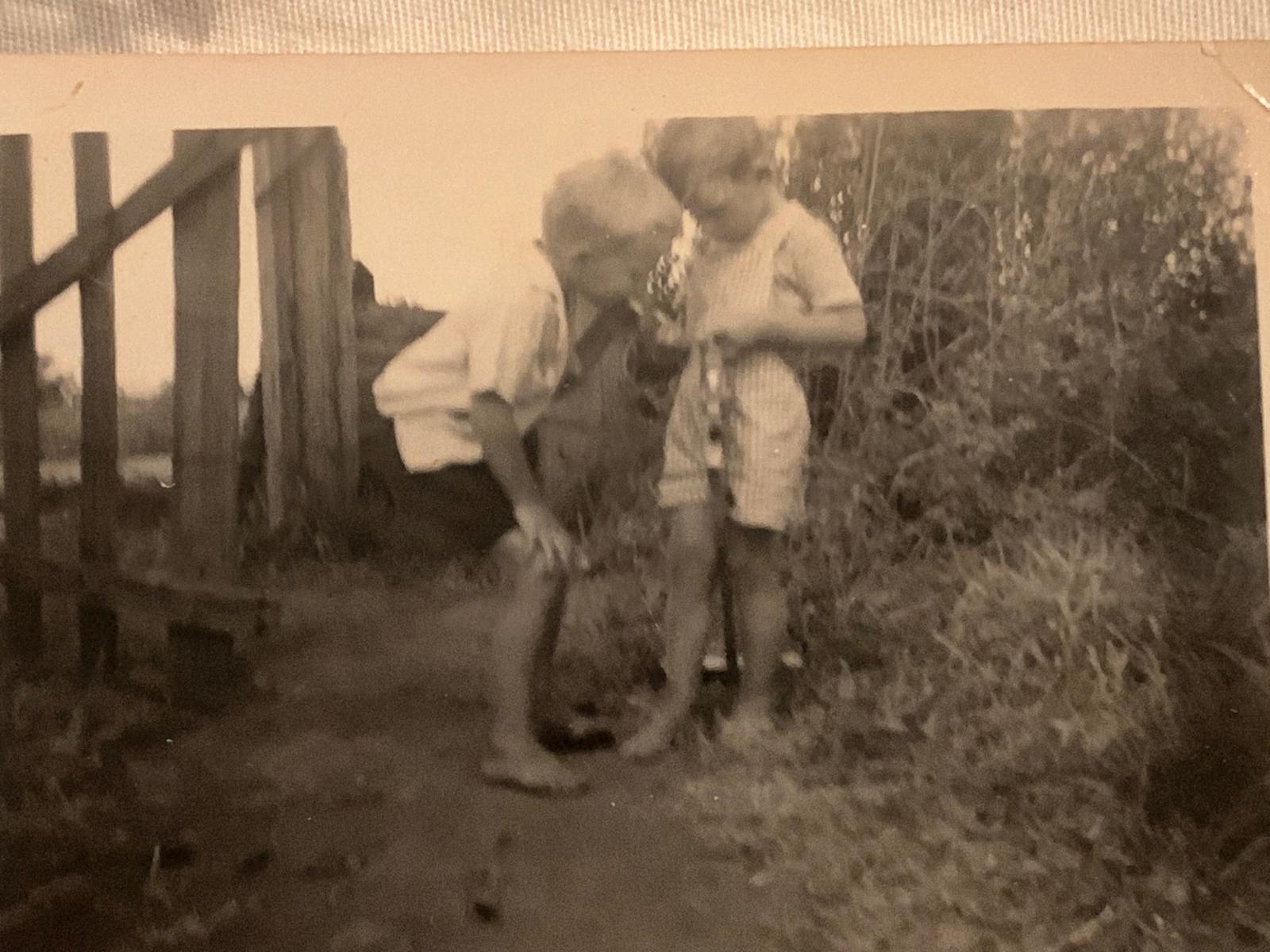
Born: September 4, 1953 in Public Hospital, Griffith, NSW
Married: December 17, 1977 in Red Bend College Chapel, Forbes, NSW to SUSAN MARY CUTCLIFFE (Born September 8, 1955)
Children:
Rebecca Maree: Born: September 17, 1978 in Hay, NSW
Nicholas Michael: Born: January 13, 1980 in Port Macquarie, NSW
Melinda Therese: Born: May 25, 1982 in Narromine, NSW
Jodie Anne: Born: September 9, 1986 in Dubbo, NSW
Mary’s Memories
When Mick was six weeks old we packed him in a tomato box and took him to Bourke. When he was a toddler he set fire to my bed. I was reading to him and dozed off. We had been to Bourke a few days before and bought new sheets, blankets, and a bedspread. I had dreamed of this for a long time. While I slept he managed to get a fire going and I woke up to find the bed in flames, jumped out and left him. Jim rescued him and put the fire out. My lovely double-bed clothes ended up as singles.
We were in the shearing quarters at this time, so Mick was about four. One night I did the rounds before going to bed and found Mick, legs spread out and a cat had had kittens between his legs on the bed. Jimmy to the rescue, I grabbed Mick, then the sheets with the offender and her family.
Mick started school at South Forbes. He loved school, was a good athlete and footballer. He went to Teachers’ College at Castle Hill Catholic College of Education in Sydney.
The night Jim went to Enngonia before he was killed, Mick stood with me and watched the car drive away. There was a full moon that night and Mick said, “Look Mum,he’s gone to the moon.” For years he believed his father was on the moon watching over us – I’m sure he still is.
Michael’s Story
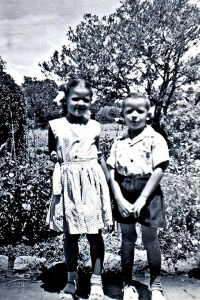
I don’t actually ever remember leaving “Rostella” to live in Forbes. But I do remember moving in to the house. The house was a mysterious looking place, unlived in for some time. It was on what seemed to be a huge block with stables and what was called the jungle on one side, and a large vacant area on the other. (Ed. note: The stables were on the northern side where Jeff Coles built the flats). The yard was overgrown with grass and, inside, the house was very dusty.
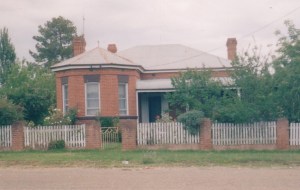 Being only five years old at the time, everything looked huge. The rooms were huge, the hall was huge and the fireplaces and chimneys – seven, including the kitchen and laundry – were huge. I don’t remember the initial settling in time but in the ensuing years this was our home for a large slice of our life. It was a home that was particularly well suited to the lifestyle of this unusually large family. We definitely tested out the old building (built around Federation or Victorian style) with our many games in, out and under the house. One particular game which was quite popular was indoor cricket (which, as a result, became a very popular game in later years). The bowler would pound along the back verandah, stepping over broken floorboards, bowl from the back step of the hallway to the batsman who was standing at the front door.
Originally the front door had the period coloured glass in the door panels and around the door frame. Gradually these were replaced by masonite as the games continued. (No $100,000 prizes for hitting the ball through the ‘O’ in those days) (Ed. Note: Actually this probability was foreseen and the coloured glass panels were removed before they were broken. They were put into the cellar where they lay undisturbed until the house was sold in 1992.)
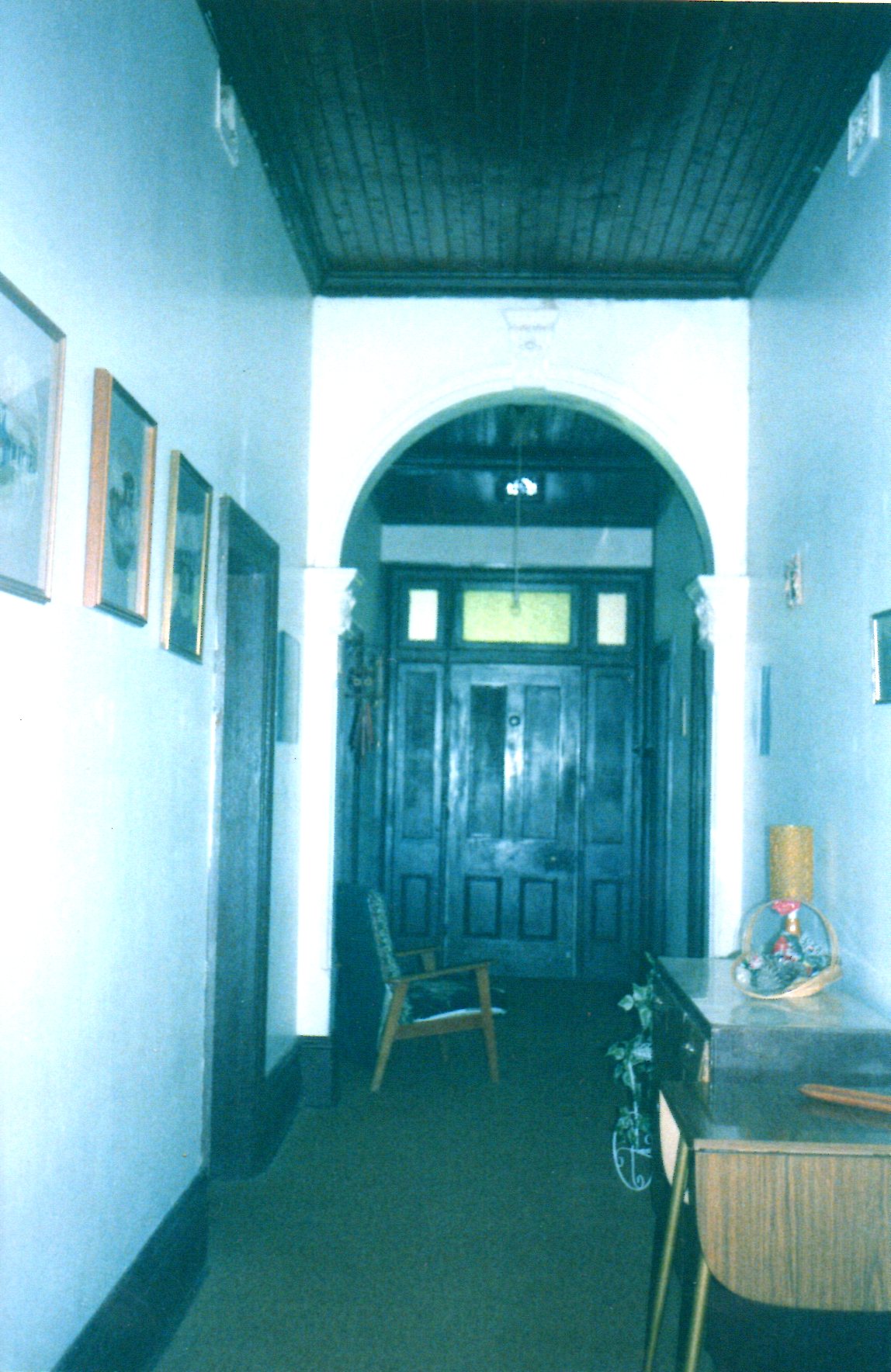
Often the wicket-keeper stood on the front verandah waiting for the catch behind. If he missed then the ball went to the front fence or out onto the street for four runs or sundries. Runs were not often ‘run’ as it became too congested in the hall with fieldsmen and batsmen running around. Instead runs were awarded according to whether you hit the ball past the archway pillars.
Outdoor cricket was very popular too and I am sure that every one of the windows along that side of the house were broken at some stage. To preserve the windows the rule “against the wall on the full is out” was implemented.
Touch footy – another game played between brothers and friends, (as a result, this too became popular worldwide), was played on the large area beside the house. It was just like a mini football field. Mum’s garden consisted mostly of hardy native shrubs which adapted to survive the pounding of being ‘forced into touch’ or ‘diving for a try” The numbers playing ranged from two or three to seven or eight a side depending on how many neighbourhood kids were around for a game. We learnt many skills from backyard football which were to help us in our senior football years.
The back wall was a great place for practicing tennis as there were no windows. John could see the potential here and painted a net across the wall. This was great for practicing serves and volleys etc at the right level.
The roof of the house took a pounding as we often had to retrieve footballs, cricket balls and tennis balls out of the gutters, behind a chimney or on the apex of the roof, which was flat. The bullnose verandahs, with no supporting beams, became dented and the gutters bent. The lead on the roof, which served as a type of sealing, became treasured as it was useful in bottle tops for the popular bottle top game played at school at the time. It was also great for melting just for the fun of it.
The ceiling was also a great place to go as you could stand up and walk around on the beams. Under the house had its attractions but it was hard to manoeuvre around because the foundations under each wall were double brick to the ground. However, Chris and a friend forged passageways under each room and underneath was a wonderful playground. This was for a limited time as we were caught out eventually.
To someone going through his childhood, Hill Street and the surrounding environment was a wonderful playground. The jungle behind Meaghers, the railway bridge and other places. The house at No. 11, as it was then, was a terrific home and all members of the family have many happy memories of their time there with Mum.
GAMES WE PLAYED
I was always fascinated by stories of the ‘olden days’ and how our parents lived and recreated in their youth. I vaguely remember stories about horses and sulkies, T-Model Fords, carpet snakes living in huts etc.
Of course, at the time, I thought I lived in the modern era with cars, tractors, some bitumen roads, ramps, wireless and later black and white TV. I presumed this era would last forever. Now I realise those days are the olden days.I am convinced of that when I realise that I can’t imagine our offspring without Barbie dolls, Sega games, videos, ten speed bikes, body boards, in-line skates, computers and other games of this generation.
On our regular holidays to “Rostella” as youngsters we amused ourselves with imaginative games that lasted for days. One of the most popular was cars and farms. Empty fish cans (the elliptical shaped ones) made great cars when filled with dirt and pulled along with string. They also graded the road as they went along the dirt. Huge paddocks were pegged out using chips from the wood-heap for fence posts. You can imagine what a hazard this presented to any full-size vehicle that happened to drive over the area.
The paddocks were filled with sheep. Sometimes the ‘sheep’ were cedar tree berries imported from Forbes. I think the prize ‘merinos’ were local gumnuts. Sheep yards, mustering, transporting and buying and selling were all part of this never-ending game.
Another non-equipment game we played for hours was ‘horses’. A few trees down by the creek near the shearers hut had springy branches close to the ground that bent in a saddle shape. These branches were bounded on for hours of riding. Tony and Greg were often the recipients of a fast jog or a long, loping canter.
Then there were the butter bushes. The butter bushes growing on the red sandy soil not far from the house and huts were great for cubby houses. The tomahawk and axe often disappeared into the butter bushes somewhere, where we constructed elaborate cubbies.
Swimming. In those days we didn’t have the luxury of Sport and Recreation swimming lessons. We learnt to swim in a muddy creek which was fed by the artesian bore. This was a wonderful play spot. Some days were so hot you couldn’t walk on the ground barefooted, even with our thick soles. The chooks would keel over dead. The creek, which became reasonably shaded late in the afternoon, was then a most inviting spot. There we would have dolphin races, running races, jumping off trees and sliding down the bank. Even catching a leech became a sport as we threw it out into the sun to shrivel up and reduce the leech population.
Yabbying was a popular past-time. A hunk of meat, a piece of cotton and a saucepan each and we dragged in hundreds of yabbies. We then boiled these alive and ate the tails.
As we grew older these games became less appealing and other forms of entertainment appeared. Back in Forbes where there was electricity, something very new was coming into the lives of the Australian people. It was about 1963 when television came to Forbes. At first there were only a few with the tell-tale aerials. (They’ve got TV!) Plus a few in the shop windows which people watched as if they were at the movies. I remember some people in the neighbourhood had TV before us. It was quite acceptable to go to their place, (me, Chris, Kathy, Pat, Tony and Greg) and plonk yourself on the lounge and watch TV. We used to visit the Coopers, Coles and Meaghers. Sometimes we would go together, other times we would split up and share ourselves around. We were mesmerised by the black and white ‘box’ with shows like “The Mickey Mouse Show”. We had to be told, “You can go home now if you like.” The reply was sometimes, “oh no, we are going to watch Laramie at 10.30.”
Eventually mum gave in and bought us a telly to keep us home if nothing else. I remember it was a good feeling to have that aerial on the roof as a status symbol which told everybody, “We’ve got a telly!”
Survival of the Fittest – 1950’s – 1970’s
Surprisingly, most of us survived our childhood without permanent disabilities. These days there are the road accidents, sporting accidents and other hazards with which we have to contend. in those days there were the child accidents caused by a hazardous environment for sure. But I think most of them had to do with the child’s curiosity.
There was Chris trying to drown himself when he pulled a panel gate down upon himself which pinned him in the mud. For his exploits Chris was given some space in a national newspaper. From the most serious to the funniest when Tony fell in the ‘pit’. He was about two. We were dressed up waiting for the Rosary nuns to visit. Tony went missing. We searched everywhere but he couldn’t be found. Eventually I had to go to the outhouse standing out in the middle of nowhere to answer a call of nature and, lo and behold, as I looked down in to the deep dark pit I saw his face looking up at me. Quick as a flash I went and told Mum. Being a deep pit he was out of Mum’s reach, however, someone had the bright idea of removing the whole tin can pedestal and he was soon rescued, washed in the laundry tub and dressed spik and span just in time for the nuns visit. I have often thought this would make a great theme for a country & western song. I have tried to compose it but can’t get past the first verse. Try this:
Tony ‘as fell down the dunny
Tony ‘as fell down the loo
Tony ‘as fell down the dunny
We don’t know what he was trying to do
Tony all dirty and snotty
‘As disappeared from our sight
‘E should’ve been sitting on the potty
And he wouldn’ve ‘ad this plight.
Maybe someone could finish it for me. (Ed. note: Don’t give up your day job!)
…..Then there were the firebugs. All kids seem to have a fascination for fire and we were no different. Our fascination almost led to disaster in a few instances. I remember one morning sitting under Mum and Dad’s bed lighting a match and putting it to the edge of the bedspread dangling invitingly over the side of the bed. The rest is a blur. Dad flew out of bed beating the flames out with his hands and then me. In later years I was to learn that it was a new bedspread and the only one that mum had ever had.
Then there was the time John dropped a match into what he thought was an empty drum to see what was in it. He was lucky to escape with scorched hands. I don’t remember it happening but if most of us were there it would explain why we are hard of hearing.
Then there was Pat. He loved matches too and set fire to the bower shed and burnt it to the ground Then he ran away and hid but he must have turned up, presumably for a feed.
Then there were those with an odd taste for kerosene. Tony tried it in Yenda while visiting grandmother. He had a quick trip to Griffith Hospital. Some time later he tried to feed it to Greg at home in the laundry. He wanted to “fill him up with petrol”. It made him go all right. Another trip to hospital. Not so fast this time. First we had to make the trip to Ted Rooney’s, four or five miles of sandy, winding track and gates. Ted seemed to be the local ambulance driver and his station wagon served as an ambulance. I remember a cloud of dust as Ted took off for Bourke about 90 miles away, with Greg and Mum. I presume Mum had to open the 10 or 80 gates before they got to the shire road.
Probably these things helped to save us from shooting each other as we grew older and pursued the excitement of pig shooting. One, there was a limited supply of guns; two, Jimmy was always on to us about gun safety; and three, we were all members of the cadets in secondary school and learnt all the safety requirements. When you’re young, however, when the adrenalin is pumping and a pig is darting from the lignum across the open country to a gully it was hard to think ‘safety’. Where was this or that brother? Thank goodness he is beside me. Bang! Another pig bites the dust. bang! Another wasted bullet, another lucky pig. Or lucky brother? What’s the difference?
 The Watts Family